
San Luis Obispo County Released Inmates
A San Luis Obispo County jail release is a change in custody status, not a promise that every detail is shown on a public release page. The Sheriff-Coroner operates the San Luis Obispo County Jail and publishes a Who's in Custody lookup for people currently held in the county jail. When a person leaves that current-custody view, the next record may live in the sheriff booking detail, the Booking Log, the San Luis Obispo Superior Court case, VINELink, the Sheriff Records Unit, or, after a state-prison transfer, CDCR.
The local custody map matters. A person released from the county jail or Honor Farm follows the county sheriff and court record path. A person moved into the Sheriff's Alternative Sentencing Unit may be serving a sentence through home detention or work program rules rather than sitting in a jail unit. A person released from California Men's Colony follows CDCR, CIRIS, parole, and Board of Parole Hearings sources. Juvenile custody is a separate restricted system and should not be treated as a public adult released-inmate lookup.
Release clue: a missing current-custody result may mean release, transfer, a spelling mismatch, a data delay, or a restricted record. Confirm the time and manner of release before relying on the status.
San Luis Obispo County Release Types
Released San Luis Obispo County inmates leave the jail record trail for different reasons. Some exits are short and clear, such as bond, own-recognizance release, dismissal, or time served. Others are transfers, so the person is released from the county jail but not from custody. A CDCR transfer, an ICE hold, a federal pickup, or a move to another county changes the search system. The sheriff booking data and the court case number are the links that help connect the local booking to the next agency.
| Release type | What it means | Where to check next |
|---|---|---|
| Bond or own recognizance | The person leaves jail while the case continues. | Sheriff detail page, court case, VINELink status, records request. |
| Time served or sentence completion | The jail term ended based on the court order and credits. | Court minute order, jail records, Booking Log clues. |
| Probation or PRCS | Custody ends but local supervision may continue. | San Luis Obispo County Probation and court disposition. |
| Transfer to CDCR | The county jail release is a move into state prison custody. | CDCR CIRIS, CDCR records, BPH where relevant. |
| Federal or ICE transfer | The county release may become federal criminal or immigration custody. | BOP locator, ICE ODLS, USMS or ICE contact paths. |
| Alternative sentencing | The person may serve through HDP or AWP instead of full in-jail time. | ASU, court remand order, sheriff booking record. |
San Luis Obispo County Release Records
The release record is usually a set of linked fields rather than one public document. San Luis Obispo's sheriff detail view can show the inmate ID, booking number, booking date, projected release, bail, physical descriptors, charges, bond numbers, arresting agency, and a VINELink registration link. The backing Booking Log XML adds fields such as InmateActive, FacilityName, DateIn, court docket number, and ProjectedReleaseDate. Those fields are useful, but the XML does not provide a simple final ReleaseDate label.
The court record often explains why the jail status changed. A San Luis Obispo Superior Court case may show a dismissal, plea, sentence, probation grant, warrant recall, future hearing, or remand order. California law also requires public access to core arrest and release information unless a safety or investigation limit applies. That makes the records request path important when a public search shows a clue but not the full release reason.
| Field | What it shows |
|---|---|
| Booking number and inmate ID | Ties the request to one San Luis Obispo custody event. |
| Booking date or DateIn | Shows when the jail event began. |
| FacilityName | May show SLO County Jail, ASU, or another custody/program label. |
| Projected Release | Shows an expected date, not final proof that release occurred. |
| InmateActive | A false value can be a no-longer-current clue that still needs confirmation. |
| Court docket number | Connects the booking to the court case that may explain the outcome. |
| Time and manner of release | Public release information requestable under California Government Code section 7923.610, subject to limits. |
The sheriff booking-detail screen is a useful field source for San Luis Obispo County released inmates. The source page is the sheriff's custody search detail view.
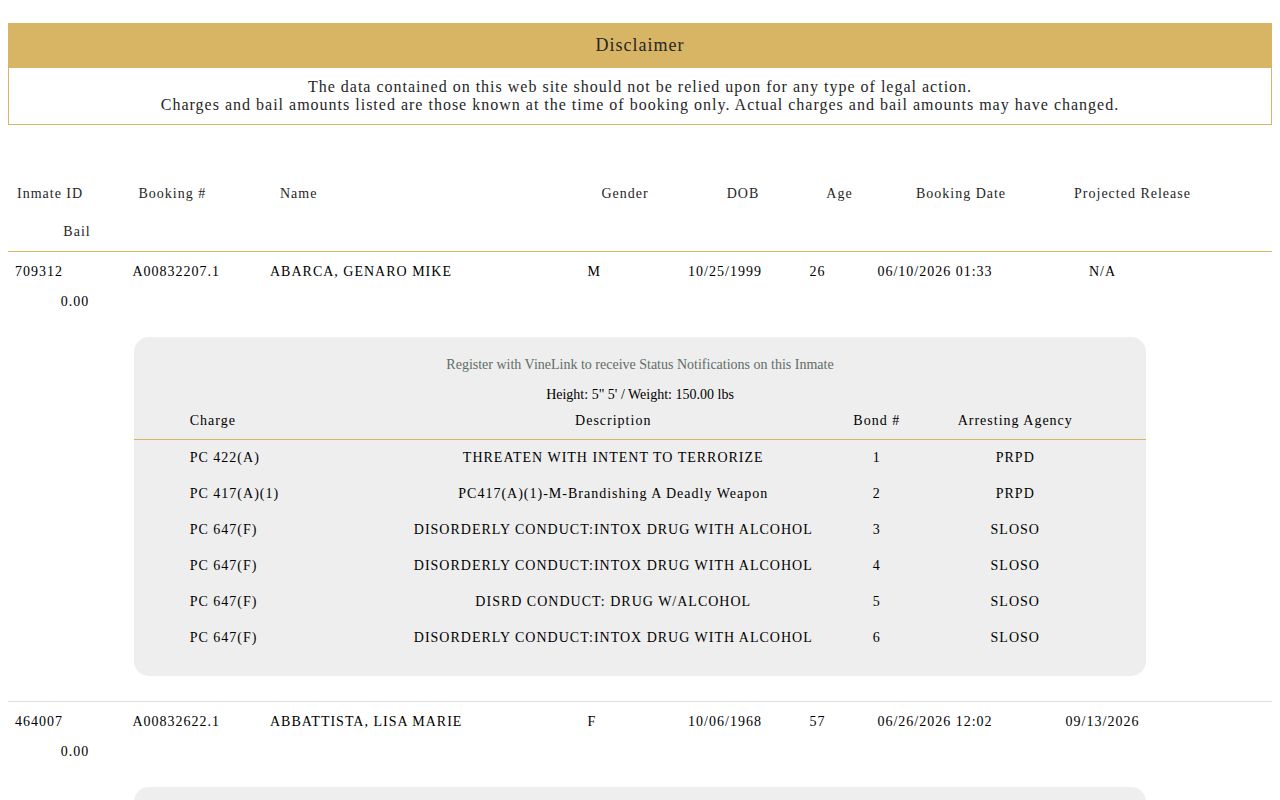
The detail fields help separate current jail custody from a projected release or later records request.
Request San Luis Obispo Release Records
When the online sources do not confirm a release, use the official records offices. The Sheriff Records Unit handles crime-report copy requests and local adult arrest information. The research file notes the Records Unit and Records and Warrants Unit at (805) 781-4140, no fee for crime-report copies, and general processing within 10 business days, with redactions possible. The county also provides a Public Records Act request path when the correct department is unclear.
- Collect the person's full name, booking number, booking date, date of birth if known, and court docket number if available.
- Check the sheriff current-custody lookup first so the request does not mistake a still-jailed person for a released person.
- Ask the Sheriff Records Unit for public arrest and release information tied to the booking, including time and manner of release if available.
- Use the court's criminal case request process for minute orders, case summaries, sentencing records, or dismissal records.
- If the person transferred to CDCR, use CDCR records and CIRIS rather than a county jail release request.
Sheriff Records and Jail Contacts
San Luis Obispo County Sheriff-Coroner
1585 Kansas Avenue
San Luis Obispo, CA 93405
Main line: (805) 781-4550
Jail information: (805) 781-4600
Records Unit: (805) 781-4140
San Luis Obispo Superior Court supplies a second path for case records. The court's criminal case information request page says copies may be requested by mail, email, or in person, but not by fax. Requests may take up to 30 days. Copies are $0.50 per page, case-summary copies are free for defendants and attorneys of record, and certified case summaries cost $40 per case.
California Release Record Law
California Government Code section 7923.610 is the core local arrest and release information statute. It requires state and local law-enforcement agencies to make public specified arrest information, including name, physical description, arrest and booking times, arrest location, factual circumstances, bail amount, current holding location, charges, and the time and manner of release, unless an exception applies. That statute does not force San Luis Obispo County to publish a full online release archive, but it supports a focused public-records request when the online tools stop short.
Record-cleaning orders can change later public visibility. The San Luis Obispo Superior Court cleaning your record page describes local dismissal, felony reduction, certificate of rehabilitation, and pardon paths. Juvenile records, sealed records, investigative details, and some booking-photo requests may be restricted. A release from jail also may leave supervision in place, so a court order or probation record can be more useful than the jail roster alone.
- Discharge
- A custody or supervision event has ended under the controlling agency record.
- Time served
- The court credits custody already served toward the sentence.
- Parole
- State supervision after a prison release, handled through CDCR and BPH paths.
- Probation
- Local court-ordered supervision that may follow or replace jail time.
- Detainer
- A hold or pickup request from another agency, such as ICE, another county, or federal custody.
Find Released San Luis Obispo Inmates
The best search path for San Luis Obispo County released inmates is a ladder. Start with the county source that would show the person if still in jail. Then use systems that explain why the person left or where custody moved. This sequence avoids the common mistake of treating a missing jail roster result as proof of community release.
- Search the sheriff Who's in Custody page by first and last name.
- Check the Sheriff Booking Log for recent booking activity and inactive status clues.
- Use the booking-detail page to capture the booking number, projected release, bail, charges, and VINELink link.
- Search the San Luis Obispo Superior Court case lookup for disposition, future hearings, or sentence orders.
- Search CDCR CIRIS if the person may have transferred to state prison or been released from a CDCR facility.
- Use VINELink for status notifications, then confirm final release details with sheriff records or court records.
- For federal or immigration custody, use BOP, ICE ODLS, or USMS sources instead of the county jail roster.
The county's named-person search is broader than the same-day feed question covered on the 24-Hour Releases page. For expected jail dates, the local field is covered through the Release Date Lookup page.
CDCR Search for Released Inmates
CDCR's California Incarcerated Records and Information Search, or CIRIS, is the state-prison path for San Luis Obispo County cases that moved beyond county jail. The CA.gov service description says CIRIS results include name, CDCR number, age, current location, commitment counties, admission date, and Board of Parole Hearing dates and outcomes for people currently in CDCR custody. For San Luis Obispo County, CIRIS is most useful when a local jail release was really a transfer to CDCR or when the person was released from California Men's Colony.
Use CIRIS with care. The state search is not a complete county jail history, and a missing result does not prove that no state record exists. If a person has BPH hearing dates, parole outcomes, or a CDCR number, the state-prison record path has replaced the county jail path. If CIRIS does not answer the question, use CDCR records, BPH schedules or results, parole operations, and the sentencing court record.
| CIRIS field | How it helps |
|---|---|
| Name and CDCR number | Matches the person to a state-prison record. |
| Current location | Shows whether the person is in a CDCR institution or another listed status. |
| Commitment county | Can connect the prison case back to San Luis Obispo County. |
| Admission date | Shows when state custody began. |
| BPH dates and outcomes | Supports parole-hearing and release-date verification. |
The CDCR search page is the official state-prison starting point at CDCR CIRIS.
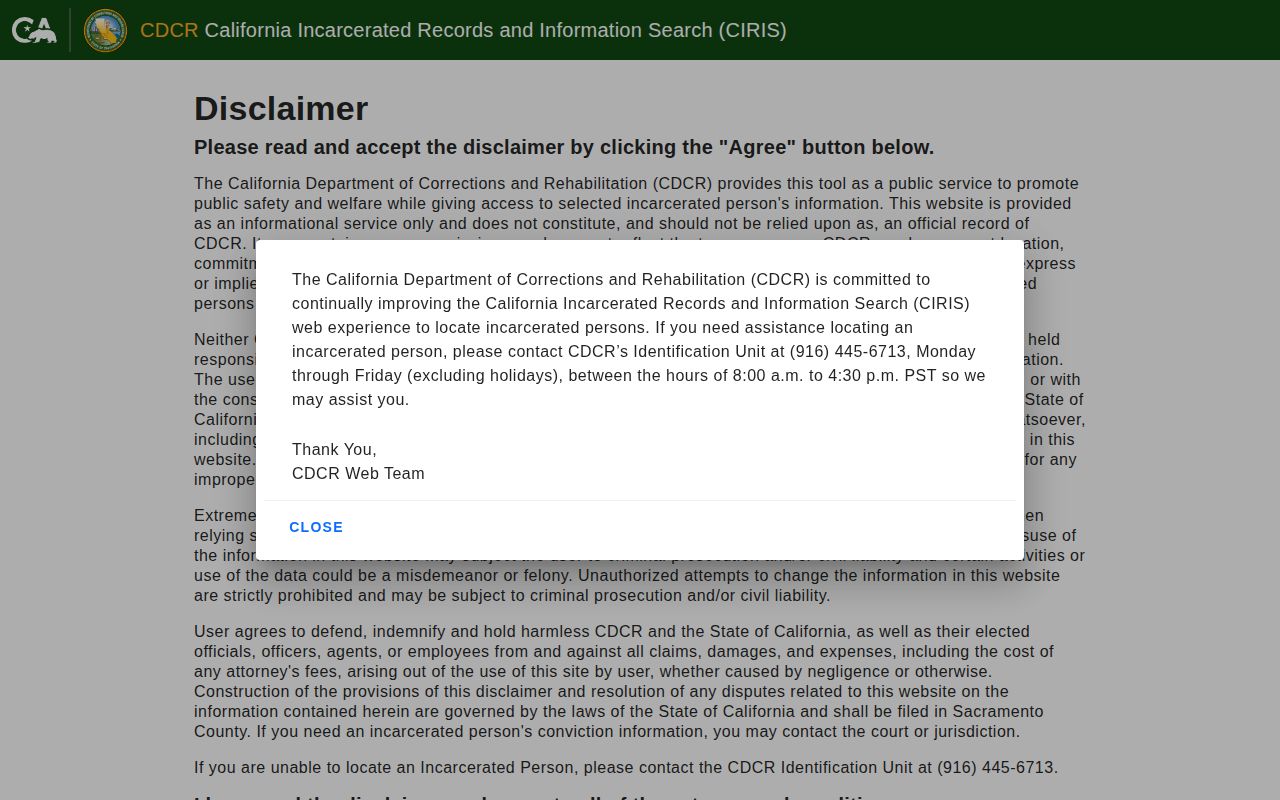
CIRIS belongs to the state-prison lane, so it should not be used as a substitute for a San Luis Obispo County jail release record.
San Luis Obispo Recent Releases
San Luis Obispo County does not publish a separate official page labeled as a 24-hour release list, 72-hour release list, recent releases, or released in the last 72 hours in the sources reviewed for this build. The official public sources are the current-custody lookup, the Sheriff Booking Log, the booking-detail page, and the booking-photo page. The Booking Log is the closest recent-activity source, but it is not labeled as a release-window feed.
The Booking Log data is delayed by a minimum of one hour. Its XML includes active and inactive entries, facility names, booking dates, projected release dates, charges, case numbers, court docket numbers, and active flags. That makes it useful for clues. It also makes precision important. A past projected release date or an inactive flag should lead to verification through the jail, records unit, VINELink, or court case, not to a claim that the sheriff has posted a confirmed release list.
The sheriff Booking Log is the local recent-activity source closest to a release feed.
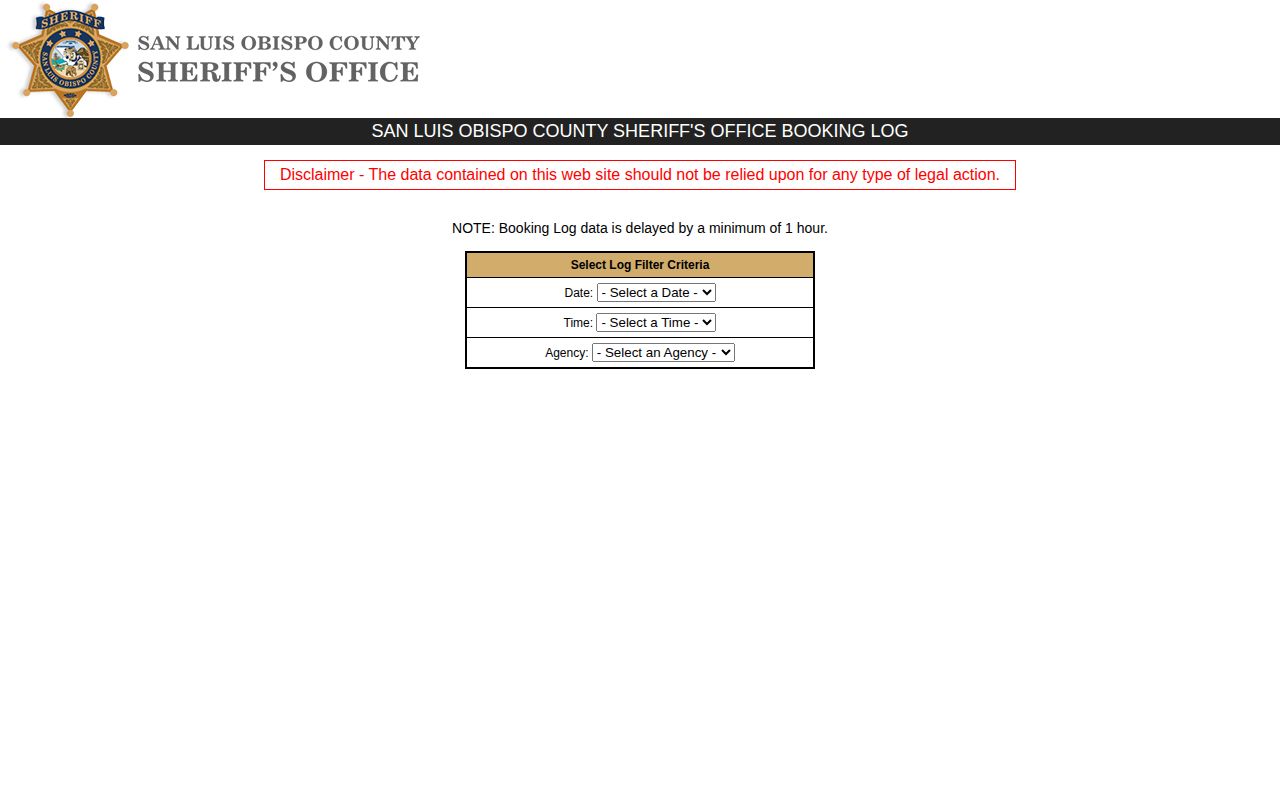
The log is useful because it exposes booking activity, but its fields still need status confirmation for a release record.
San Luis Obispo Release Pickup
San Luis Obispo has unusual release logistics detail in the Probation Department's Bag and Baggage procedure. For a probationer release to a program or agency pickup, the procedure calls for confirming the release date, pickup date and time, agency or person, pickup name, and contact number. It also says B&B releases should not be scheduled during listed lockdown hours or during preferred shift-change avoidance periods. That local detail shows why a release may be coordinated rather than a simple walk-out.
For family or agency pickup, the same procedure asks for the pickup person's relationship and phone number. A Deputy Probation Officer pickup includes a call-ahead instruction. These details do not create a public release list, but they do explain why the court, probation, jail programs, and booking staff may all be part of a release confirmation.
Note: coordinated pickup details apply to the documented probation procedure, not every San Luis Obispo County jail release.
San Luis Obispo Alternative Sentencing
The Sheriff's Alternative Sentencing Unit changes some short-sentence release questions. The sheriff says the Home Detention Program applies to sentenced incarcerated persons with 21 days to 1 year in the County Jail. The Alternative Work Program applies to persons sentenced to 20 days or less, with eight hours of general labor substituted for one day of jail time. The sheriff's page also states that fees are no longer required for the Alternative Sentencing Program.
Because HDP and AWP affect where and how a sentence is served, a person may not fit the usual recently released pattern. The better confirmation path is the court remand order, ASU contact, and sheriff booking or custody record. If the public custody search does not show a sentenced person, alternative sentencing approval is one possible explanation, but it should be confirmed rather than assumed.
San Luis Obispo Post-Release Supervision
Some San Luis Obispo County releases are followed by supervision. Parole is the state-prison supervision path handled through CDCR and, for hearing cases, the Board of Parole Hearings. Probation, PRCS, mandatory supervision, and local sentence supervision are tied to the court and San Luis Obispo County Probation. The Sheriff Records and Warrants FAQ routes disposition questions to the Superior Court, District Attorney, or Probation Department depending on the case.
Local reentry records are also part of the picture. San Luis Obispo County jail-based behavioral health services describe clinical intake, assessment, and pre-release services that link people with re-entry services and Post Release Treatment Services. The county's Stepping Up plan targets increased treatment connection upon release and early discharge planning. Verification of legal status still comes from the court, sheriff, CDCR, or probation record. The broader supervision workflow is handled on the Post-Release Supervision page.
VINELink and Federal Releases
VINELink is the documented notification layer for San Luis Obispo County jail custody changes. The sheriff inmate-detail page includes a link to register with VINELink for status notifications on an individual inmate. VINELink can help with a release, transfer, or status-change alert when the participating agency feed supports it. It does not replace the sheriff release record or court disposition.
Federal and immigration releases use different systems. The BOP inmate locator covers federal inmates from 1982 to the present, and BOP explains that a past release date with no facility location means the person is no longer in BOP custody. ICE's Online Detainee Locator System covers current ICE custody and, according to ICE attorney resources, people released from ICE custody within the last 60 days. The sheriff menu's TRUTH Act Data Center makes the ICE-transfer distinction relevant locally: a county jail release to ICE is not a release to the community.
San Luis Obispo Release Lookup
Use the search source that matches the custody system. A live jail roster is strongest for current county custody. A release record request is strongest for the final time and manner of county release. CIRIS is strongest for state-prison custody. BOP and ICE answer separate federal or immigration questions.
| Status question | Best source | San Luis Obispo caution |
|---|---|---|
| Still in county jail? | Sheriff Who's in Custody | Current custody only, not a full release archive. |
| Recently booked or inactive? | Sheriff Booking Log and XML | Delayed at least one hour and not a labeled release feed. |
| Why did the case change? | Superior Court case record | Court records may outlast roster visibility. |
| Moved to state prison? | CDCR CIRIS and CDCR records | County release may be a transfer, not freedom from custody. |
| Federal or ICE custody? | BOP, ICE ODLS, USMS or ICE contacts | County tools do not control those systems. |
Does inactive mean released? Not by itself. Inactive status is a useful San Luis Obispo Booking Log clue, but final release should be checked through the jail, court, VINELink, or records unit.
San Luis Obispo Court Records
San Luis Obispo Superior Court moved public case access into re:SearchCA. Remote public access requires registration, while courthouse kiosks are available without registration. Criminal documents can be viewed on onsite kiosks, and copies can be requested by mail, email, or in person. For older or hard-to-match cases, court procedure matters because the court says staff cannot use date of birth for third-party name search requests in pre-2014 research.
The court channel is often the durable source after the jail roster changes. A minute order, sentence record, dismissal, probation order, warrant recall, or future hearing can explain why a person left San Luis Obispo County Jail. The court does not replace the sheriff release record, but it often explains the legal event that caused the jail status to change.
San Luis Obispo Detention Facilities
San Luis Obispo County release checks should start with the facility type. The primary county jail and Honor Farm use sheriff, VINELink, court, and records paths. Alternative Sentencing uses ASU and the court order. California Men's Colony is CDCR state-prison custody. Juvenile Hall is included only as a restricted boundary, because juvenile release information is not a normal public adult inmate-search path.
- San Luis Obispo County Jail is the main adult county jail and the core sheriff release-record source.
- San Luis Obispo County Honor Farm is a sheriff custody component checked through the same jail ecosystem.
- Sheriff's Alternative Sentencing Unit covers HDP and AWP release-adjacent sentence service.
- California Men's Colony is a CDCR state prison, so release checks use CIRIS, CDCR, parole, and BPH.
- San Luis Obispo County Juvenile Hall is restricted juvenile custody, not a public adult released-inmate roster.
Public Record Search
Sponsored Results