
Alternative Sentencing Is Not a Jail Release List
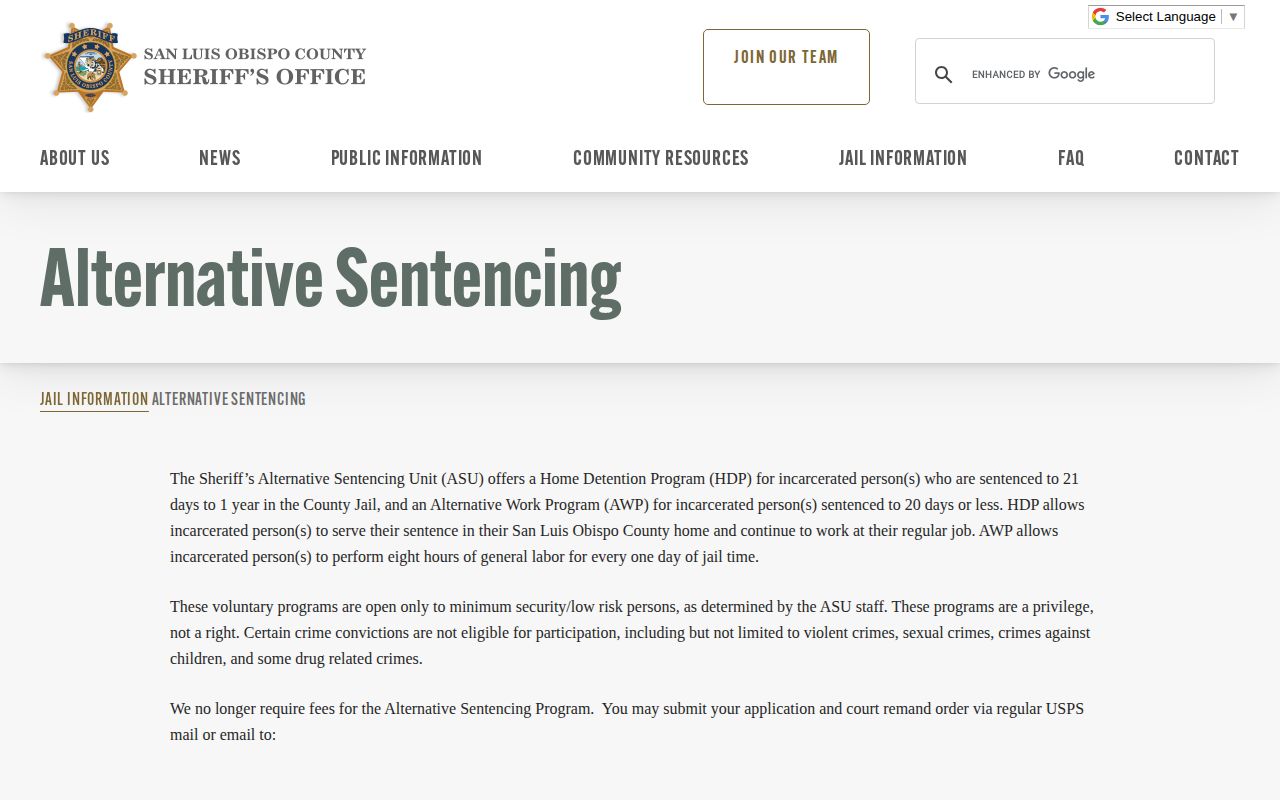
San Luis Obispo's Alternative Sentencing Unit changes the release question for short county sentences. The sheriff says the Home Detention Program applies to qualifying sentenced incarcerated persons with 21 days to 1 year in the County Jail, while the Alternative Work Program applies to qualifying persons sentenced to 20 days or less. The AWP rule described in the research is specific: eight hours of general labor substitutes for one day of jail time. These programs are voluntary and limited to minimum-security or low-risk persons as determined by ASU, with certain convictions excluded.
Because ASU changes how a sentence is served, the person may not look like a normal recent release from San Luis Obispo County Jail. The person may have a county booking, a court remand order, an ASU application, and a program schedule instead of a simple release date that appears in a public list. Confirmation should therefore start with the court order and ASU, then use the sheriff custody record to understand whether the person was booked, released from physical custody, or assigned to a program track.
The research also found that fees are no longer required for the Alternative Sentencing Program. That is a local fact worth preserving because older assumptions about program payment can mislead users. Applications and court remand orders may be sent by regular USPS mail or email according to the sheriff ASU page, and the ASU Coordinator is the named local contact for program status questions.
The sheriff Alternative Sentencing page is the source for the ASU program details shown here.
How to Confirm ASU Status
For ASU, the best question is not simply "was this person released?" The better question is whether the sentencing court and sheriff approved service through HDP or AWP, whether the person had a jail booking connected to that sentence, and whether the person remains under a program schedule or court obligation. A person may leave the physical jail setting, but that does not necessarily mean the sentence has ended.
- Locate the court case or remand order that sent the person to jail, HDP, AWP, or another sentencing route.
- Call or write the Alternative Sentencing Unit with the person's name, court date, case number, remand date, and program question.
- Check the sheriff current-custody lookup only to determine whether the person is currently listed in jail custody.
- If there was a county booking, use the booking number to compare sheriff detail fields, Booking Log clues, and court records.
- Use the Superior Court case record to confirm sentence terms, time-served orders, probation terms, or any later modification.
- Use the Records and Warrants Unit for public adult arrest or booking information tied to a sheriff booking.
If a person was transferred to CDCR instead of ASU, the search route changes to CIRIS and CDCR records. If the person was released to ICE or a federal agency, that is not an ASU completion event; the next system is ICE ODLS, USMS, federal court, or BOP. The local TRUTH Act context makes this distinction important for county-jail exits. A release from the jail building can still be a transfer into another custody system.
Alternative Sentencing Records and Contact
The ASU contact card is the central local source for program-status questions. Use it with the sentencing court record and any sheriff booking number that ties the sentence to county custody.
Program: Sheriff's Alternative Sentencing Unit / Home Detention Program / Alternative Work Program
Operating agency: San Luis Obispo County Sheriff-Coroner Alternative Sentencing Unit
Mailing address: 880 Oklahoma Ave., San Luis Obispo, CA 93405
ASU Coordinator: (805) 781-4635
Hours: Monday-Thursday 8:00 AM-4:00 PM; closed Friday-Sunday and county holidays
Related records: Sheriff Records and Warrants Unit, (805) 781-4140
When contacting ASU, keep the request narrow. Provide the court case number, remand order date, booking number if known, sentence length, and whether the question concerns HDP, AWP, completion, termination, or a missed reporting issue. For a public release record from the underlying jail booking, ask the Records and Warrants Unit for the booking and release information tied to that booking. For the sentence terms themselves, use San Luis Obispo Superior Court records.
About HDP and AWP
The Home Detention Program and Alternative Work Program serve different sentence lengths. HDP is described by the sheriff as a way for sentenced incarcerated persons with 21 days to 1 year in the County Jail to serve the sentence at a San Luis Obispo County home, subject to ASU eligibility review. AWP applies to persons sentenced to 20 days or less and substitutes eight hours of general labor for each one day of jail time. The programs are not automatic, and ASU determines minimum-security or low-risk eligibility.
| Program | Research-supported release angle |
|---|---|
| Home Detention Program | May move a sentenced person from physical jail custody to a monitored county home setting for a sentence of 21 days to 1 year. |
| Alternative Work Program | May let a qualifying person with 20 days or less serve through labor days, with eight hours equaling one day of jail time. |
| Court remand order | Controls whether the person was ordered to jail, ASU review, HDP, AWP, or another sentence route. |
| Sheriff booking record | Can show the custody event that led to ASU or the related jail release from physical custody. |
Court Records Control the Sentence
ASU status cannot be separated from the court record. The Superior Court record can show whether the person was sentenced, remanded, granted time served, moved to probation, ordered to report to ASU, or scheduled for a future hearing. The sheriff Records and Warrants FAQ routes case-disposition questions to the Sheriff Records Unit if the case was not submitted for prosecution, or otherwise to Superior Court, the District Attorney's Office, or Probation. For ASU, that routing is practical because the program sits between jail custody and court sentence completion.
The county's broader release logistics also show why not every release is a simple roster event. Probation's Bag and Baggage procedure covers coordinated releases to a program or agency pickup, requiring release date confirmation, pickup date and time, agency or person, pickup name, and contact number. ASU is not the same procedure, but both sources show that San Luis Obispo has structured handoffs and sentence-service routes that do not fit a one-line release list.
ASU Boundaries for Released-Inmate Searches
The ASU page should not be used as a county jail recent-release page, a state-prison page, or a juvenile custody page. A person in ASU may have left the physical jail, but still be serving a sentence through a court-approved program. A person absent from current custody may have completed a sentence, transferred, entered a program, or been removed from the public view for another reason. Use 24-Hour Releases and 72-Hour Releases for the local recent-release workflow, and use Release Date Lookup when the sheriff detail shows a projected release field. For supervision after custody, use Post-Release Supervision.