
San Luis Obispo Projected vs Actual
San Luis Obispo’s local jail data has a real projected-release field. The sheriff inmate-detail page labels it “Projected Release,” and the Booking Log XML uses `ProjectedReleaseDate`. That field may show a date, a date-time, N/A, or a blank value. It is best read as the jail system’s current estimate based on the booking, sentence, credits, holds, and data available at that time.
Scheduled is not final. A projected release date is a planning and status field. Actual release must be confirmed through custody status, VINELink, the court docket, sheriff records, CDCR, or the agency that received the person after transfer.
For pretrial custody, there may be no set release date at all. The person may leave after bail is posted, bail changes, an own-recognizance order, a dismissal, a new court order, or a transfer. For sentenced county-jail time, credits and Classification work can produce a projected date. For a state-prison sentence, CDCR and BPH date labels replace the county jail field.
Find San Luis Obispo Release Date
The lookup starts with the system that owns the custody. A San Luis Obispo County Jail date belongs to sheriff and court records. A California Men’s Colony or other state-prison date belongs to CDCR, CIRIS, and sometimes BPH. A release to federal or immigration custody belongs to BOP, USMS, or ICE. The date printed in one system may only mark the end of that system’s custody.
- Search the San Luis Obispo Sheriff Who’s in Custody page by first and last name if the person may still be in the county jail.
- Open any matching sheriff detail result and record the booking number, booking date, projected release field, bail, charges, case number, and VINELink registration link.
- Check the Booking Log and, where useful, the booking data fields for active or inactive status, facility name, and `ProjectedReleaseDate` clues.
- Use San Luis Obispo Superior Court online case lookup for bail changes, remand orders, sentencing, probation, dismissal, future hearings, or transfer orders.
- Search CDCR CIRIS when the person was transferred to state prison or released from California Men’s Colony.
- Use VINE Inmate Check for custody-status notifications when the sheriff detail or VINELink search supports registration.
- If online records do not confirm the date, contact the Sheriff Records Unit or request public release information tied to the booking.
San Luis Obispo Jail Date Field
The county field is useful because it is local and booking-specific. It should not be stretched beyond what it says. A projected date in the San Luis Obispo jail system is not the same as a signed release order, a court minute order, or a supervision discharge. It reflects the jail’s known facts at that moment. Those facts can change after a court appearance, a warrant hit, a hold from another jurisdiction, or a transfer decision.
The Booking Log data also has a local quirk. It can include current and inactive entries and can show `ProjectedReleaseDate`, but the research did not find a clean `ReleaseDate` field or a public page labeled as a 24-hour or 72-hour release list. That means the data can guide a records check without proving the actual time and manner of release. Use San Luis Obispo County released inmates for the wider search path when a person has already dropped from the current-custody lookup.
What Changes San Luis Obispo Dates
A release date changes when the facts behind the calculation change. The most common errors come from treating the first date seen online as fixed. San Luis Obispo research points to several local and statewide reasons a date can move.
| Change | Why It Matters | Where to Verify |
|---|---|---|
| New court order | Bail, remand, dismissal, sentencing, or warrant recall can alter custody quickly. | Superior Court case lookup or case-copy request |
| Credits recalculated | Conduct/work credits can affect local jail time when the person qualifies. | Jail records, Classification, and the sentencing order |
| Discipline or credit loss | Conduct-credit changes can move a projected date later. | Jail or CDCR records |
| Hold or warrant | A probation hold, parole hold, warrant, ICE hold, USMS hold, or another county hold can block release to the community. | Sheriff records, court, probation, CDCR, ICE, or USMS |
| Transfer | Release from county custody can mean transfer to CDCR, another county, federal custody, or immigration custody. | CIRIS, BOP, ICE ODLS, court, or sheriff transfer record |
| Alternative sentencing | HDP or AWP approval can change how a county sentence is served. | ASU, court remand order, and sheriff booking record |
| Data lag or clerical update | The Booking Log is delayed by at least one hour and online fields may not update at the same pace as the jail file. | Jail information line or records request |
California Good-Time Date Rules
California Penal Code section 4019 is the main local-custody credit statute for county jail and similar settings. In plain terms, qualifying custody can earn conduct or work credits when the person performs assigned labor and follows the rules. The exact calculation depends on the sentence, statute, exclusions, facility, conduct, and court order. The public-facing release date should never be recalculated from scratch without the official record.
Penal Code section 4019 is the statute behind many San Luis Obispo County jail credit questions.
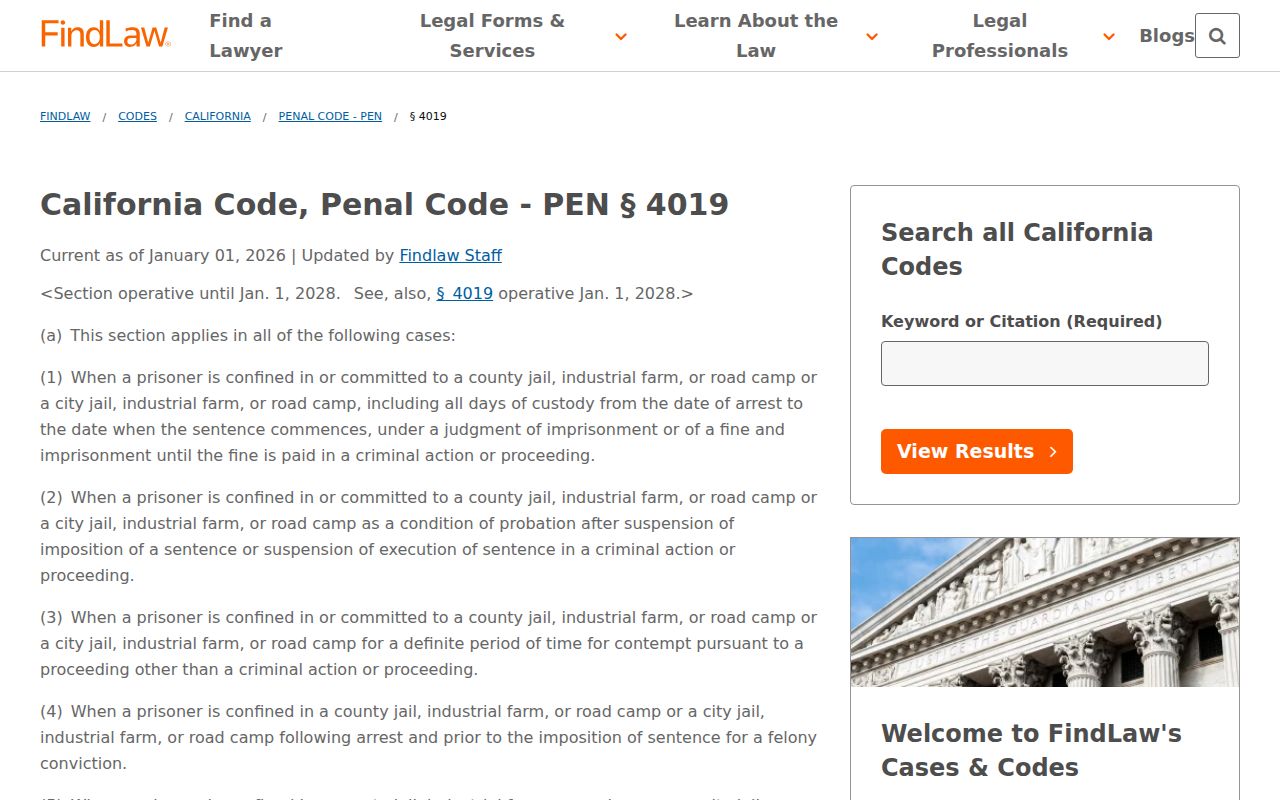
The screenshot is useful for identifying the statute, but the jail, court, and counsel-facing record control the date in a specific case.
Penal Code section 2933.1 is the source of the common California 85-percent shorthand for specified violent-felony convictions because it caps worktime credit at 15 percent for those cases. That rule is not universal. Some cases earn different credits, fewer credits, or no credits depending on the conviction and statute.
BPH Release Date Labels
State-prison dates use CDCR and BPH terms, not the San Luis Obispo jail label. BPH defines Earliest Possible Release Date, or EPRD, for a determinate prison release after credits. Minimum Eligible Parole Date, or MEPD, is used for indeterminate parole consideration. NPED is a nonviolent parole eligible date under Proposition 57. YPED and EPED refer to youth offender and elderly parole eligibility. The controlling parole eligible date is the earliest applicable date among the relevant categories.
These labels often appear in parole or CDCR research, especially when the person was housed at California Men’s Colony or another state prison. A person sentenced from San Luis Obispo County to CDCR may have one local jail projected date for transfer and a later CDCR or BPH date for state custody. Do not merge those dates. They answer different questions.
The BPH parole eligibility explainer is the best source for these date labels and should be checked before interpreting a state-prison release date.
San Luis Obispo Classification Timing
San Luis Obispo has a local timing clue in the Probation Department’s Bag and Baggage release procedure. The procedure says early releases are calculated and prepared daily by Classifications. It also says Sheriff’s passes are prepared on Sunday, Tuesday, and Thursday for releases on Monday, Tuesday, and Friday. That does not describe every jail release. It does show why a printed projected date may depend on classification work, pass preparation, court instructions, and pickup arrangements.
For releases to a program or agency pickup, the procedure asks the Deputy Probation Officer to confirm the release date with the DPO assigned to the Jail Programs Unit and to provide pickup details. It also avoids listed lockdown and shift-change periods. That is a strong local reason to treat the projected release date as a coordination point, not as final proof of the time the person left custody.
Confirm San Luis Obispo Release
If the projected date has passed and the person still appears in custody, check for holds, warrants, new charges, a court continuance, discipline or credit changes, transfer, or data lag. If the person no longer appears in current custody, confirm through VINELink, the court docket, or the Sheriff Records Unit before stating that release occurred.
For local jail records, ask for the public time and manner of release tied to a booking. California Government Code section 7923.610 supports public access to specified arrest and release information, subject to safety and investigation limits. For court records, use the Superior Court case information request process. For state-prison releases, use CIRIS, BPH results, and CDCR records. For a federal or immigration transfer, use BOP or ICE rather than the county jail roster.
Note: A county projected release date can be real and still be incomplete. The actual release record is the final source.