
San Luis Obispo Parole vs Probation
Post-release supervision is not one record system. A person released from California Men’s Colony or another CDCR prison may be on state parole, may have a Board of Parole Hearings history, or may have CDCR release data in the California Incarcerated Records & Information Search. A person released from San Luis Obispo County Jail may instead be on local probation, PRCS, mandatory supervision, or another court-controlled status. The sheriff booking record helps identify the jail event, but the court and supervision agency explain what happens next.
The table below separates the common paths. Use it before calling an office, because the wrong office may only be able to confirm that it does not hold the record. A county-jail release to probation is not a CDCR parole case. A prison release to parole is not a county probation grant. A court disposition can also show that the person was sentenced to time served, released on own recognizance, transferred, or ordered into a local program.
| Status | Who Controls It | Where to Verify |
|---|---|---|
| CDCR parole | CDCR Division of Adult Parole Operations and, for hearing cases, the Board of Parole Hearings | CIRIS, BPH, CDCR parole records, and hearing results |
| County probation | San Luis Obispo Superior Court and San Luis Obispo County Probation Department | Superior Court case lookup, probation, and court-copy requests |
| PRCS or mandatory supervision | Local supervision tied to California realignment and the sentence imposed | Court disposition, probation contact, and any jail release record that names the handoff |
| Court disposition only | The sentencing court and case file | Minute orders, case summaries, sentencing records, and sheriff records where available |
- Parole
- State supervision after a prison release or parole-board action.
- Probation
- Local court supervision that can be ordered instead of, after, or alongside jail time.
- PRCS
- Postrelease community supervision, a local supervision path after certain prison releases.
- Mandatory supervision
- A county-supervised part of a split sentence ordered by the court.
- Discharge
- The end of custody or supervision for the record being checked.
Verify San Luis Obispo Supervision
The safest verification path follows the custody history. Start with the San Luis Obispo Sheriff booking or current-custody material if the person was in the county jail. If the person was sentenced to state prison or released from California Men’s Colony, shift to CDCR and BPH. If the person left county jail with probation terms, PRCS, mandatory supervision, a future hearing, or a probation hold, the San Luis Obispo Superior Court and Probation Department become the more useful sources.
- Search the sheriff current-custody and booking-detail path first when the event began at San Luis Obispo County Jail. Capture the booking number, booking date, projected release field, charges, court docket number, and any VINELink registration link.
- Check the court case through San Luis Obispo Superior Court. A docket, minute order, or case summary can show probation granted, sentence imposed, remand lifted, future hearing, dismissal, warrant recall, or transfer.
- Use CDCR CIRIS when the person was transferred to or released from state prison. CIRIS can show commitment counties, location, admission data, and BPH hearing dates or outcomes when available.
- Review BPH hearing schedules and BPH hearing results for parole-suitability cases. A hearing result helps explain a possible release, but it is not by itself a final release record.
- Call the correct local office if online records do not answer the question. The sheriff FAQ routes case disposition to the Sheriff Records Unit, Superior Court, District Attorney, or Probation Department depending on the case stage.
- Use VINELink for custody-status alerts. A San Luis Obispo inmate-detail result links to VINE registration, which is useful before release and for status changes.
Note: A person missing from the jail roster may have been released, transferred, or removed from the public current-custody view for another reason.
CDCR and BPH Parole Records
CDCR parole and Board of Parole Hearings records matter most when the person had a state-prison sentence. The local San Luis Obispo connection may be California Men’s Colony, a CDCR institution in the county, or a San Luis Obispo County court sentence that later moved the person to CDCR. The sheriff booking log is not the release source for a CMC prison release unless there was also a separate county jail booking.
CA.gov describes CIRIS as a California Department of Corrections and Rehabilitation search for incarcerated-person information. BPH material adds parole-hearing context. BPH schedule pages identify hearing date, time, location, and whether the hearing is in person or by video, and the research notes a Thursday weekly update cadence. BPH results are published by week. Outcomes can include grants, denials, stipulations, waivers, postponements, continuances, rescissions, en banc review, or Governor review in certain cases.
The date labels are also specific. The BPH parole-eligibility explainer defines EPRD, MEPD, NPED, YPED, EPED, and controlling parole eligible date. Those labels are not the same as a San Luis Obispo jail projected release field. They belong to California prison release and parole eligibility work.
The BPH parole-eligibility page is the best plain-language source for these labels, while Penal Code section 3041 supplies the statutory parole-hearing framework.
The captured BPH statute screenshot from California Penal Code section 3041 fits parole-release checks because it shows the legal framework behind parole consideration.
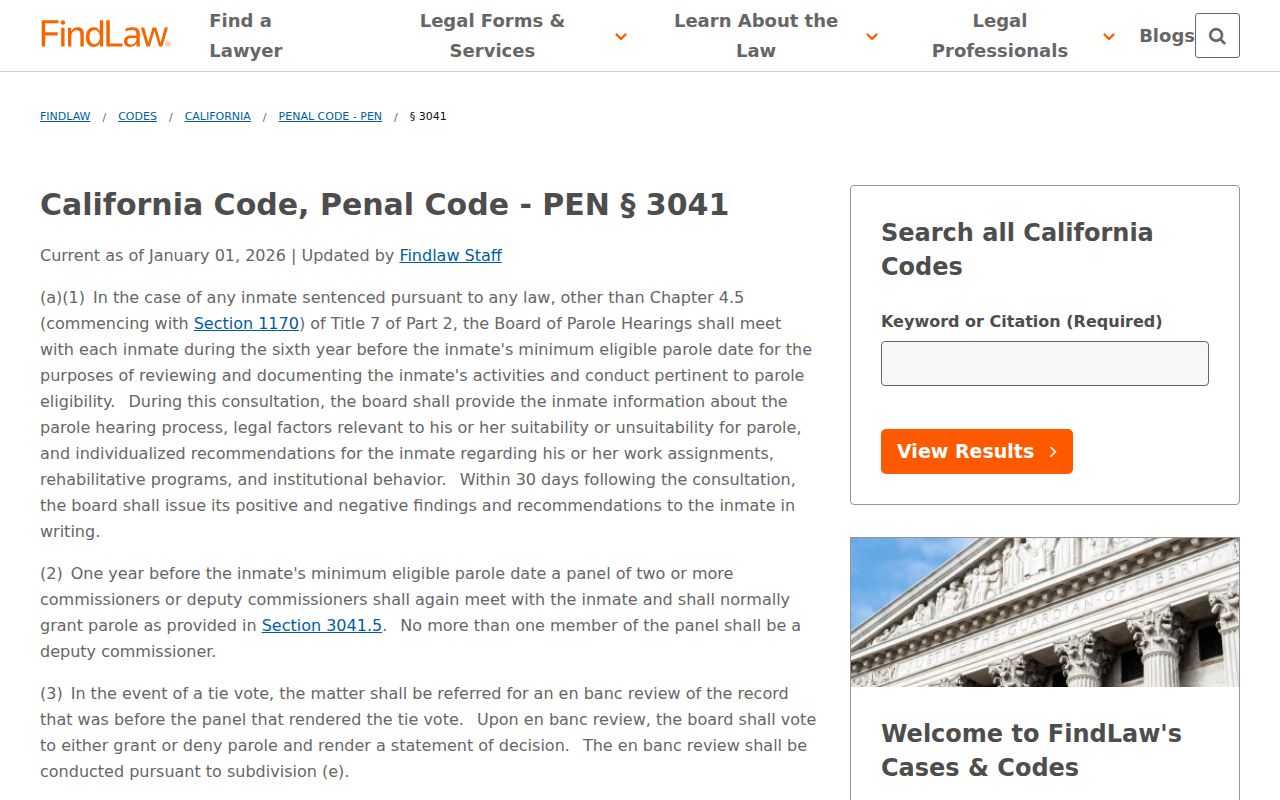
Use that statute with CDCR and BPH pages, not as a substitute for the person’s actual CDCR record or court disposition.
San Luis Obispo Supervising Contacts
County supervision checks usually turn on local records. The Sheriff Records & Warrants FAQ says case disposition may be available from the Sheriff Records Unit if the matter was not submitted for prosecution. If prosecution did occur, disposition questions may belong to the Superior Court, District Attorney, or Probation Department. That division matters because the jail may confirm a booking event while the court or probation office controls the supervision order.
San Luis Obispo County Probation Department
1730 Bishop Street
San Luis Obispo, CA 93401
Phone: (805) 781-5300
San Luis Obispo Superior Court
Phone: (805) 706-3600
Online Case Lookup
Criminal Case Information Requests
Sheriff Records Unit
1585 Kansas Avenue
San Luis Obispo, CA 93405
Records: (805) 781-4140
Jail information: (805) 781-4600
For a broader released-person search path, use San Luis Obispo County released inmates as the hub and then return to this page when the record shows parole, probation, PRCS, or mandatory supervision.
San Luis Obispo Court Disposition
A court disposition is often the deciding record after release. The sheriff may show booking facts, bail, projected release, and custody status, but the court case explains whether the person was sentenced, released on own recognizance, granted probation, ordered to time served, dismissed, continued, remanded, or transferred. San Luis Obispo Superior Court uses re:SearchCA for online public case access, with remote registration and courthouse kiosk access.
When a disposition is not clear online, the court’s criminal case information process allows requests by mail, email, or in person. The court does not accept fax requests. Research notes that requests are processed first come, first served and may take up to 30 days. Copies are $0.50 per page, and certified case summaries are $40 per case. A case summary can be more useful than a jail roster when the question is whether supervision follows release.
Question: Does a projected jail release date prove the person is off supervision?
Answer: No. It only points to a custody estimate for the jail record. A later court order, probation term, PRCS condition, parole decision, hold, or transfer can still control the person’s status.
Holds, Warrants, and Absconders
Supervision records can include holds, warrants, or absconder status. California Government Code section 7923.610 lists charges held on, including outstanding warrants, parole holds, and probation holds, among the public arrest-information categories that may be disclosed unless a safety or investigation limit applies. That does not mean every supervision detail is online. It means a purpose-neutral request for the public release or hold information tied to a booking may have a statutory path.
For county cases, ask whether the person was released, held on a warrant, transferred, or routed to probation. For state parole, use CDCR and BPH sources. For a new warrant or local disposition, use the court and the Records and Warrants Unit. VINELink can help with custody-status changes, but it does not replace the court’s order or the supervising agency’s record.
San Luis Obispo Reentry Handoffs
San Luis Obispo has a documented reentry and treatment layer that makes the supervision question more local than a simple parole-versus-probation chart. County jail-based behavioral health services include clinical intake, assessment, and pre-release treatment services. The stated purpose is to connect the person with re-entry services and support a handoff to Post Release Treatment Services. The county’s Stepping Up work also targets stronger treatment connection at release and early discharge planning.
This material does not create a public supervision roster. It explains why a released person may have a planned program handoff, probation coordination, or treatment connection that does not appear as a simple jail roster entry. When the record refers to a program pickup, residential treatment, or a sober-living handoff, use the court, probation, and jail release record to confirm the official status.
Probation Release Pickup Details
San Luis Obispo’s Bag and Baggage procedure is unusually specific. It describes probationer releases to residential treatment, sober living, or similar agency handoffs. A Deputy Probation Officer is expected to confirm the release date with the DPO assigned to the Jail Programs Unit, provide the date and time, identify the pickup agency or person, provide the pickup name and contact number, and coordinate with the Sheriff’s Department Correctional Technician.
The procedure also says Bag and Baggage releases should not be scheduled during lockdown hours listed as 0400, 1100, 1600, and 2300. Shift-change periods from 0600 to 0700 and 1800 to 1900 are preferably avoided. Classification prepares Sheriff’s passes on Sunday, Tuesday, and Thursday for releases on Monday, Tuesday, and Friday, while early releases are calculated and prepared daily by Classifications. These details show why a supervision release may be a coordinated agency handoff rather than an ordinary walk-out.
Note: Juvenile release procedures are restricted public paths; adult supervision checks should stay with sheriff, court, probation, CDCR, and BPH records.
When San Luis Obispo Supervision Ends
Supervision ends through the record system that created it. CDCR parole discharge is a state parole matter. County probation termination, modification, or successful completion is a court and probation matter. PRCS and mandatory supervision require the local record and court framework. A person may also have a sealed, dismissed, or record-relief order that changes what remains visible in later public searches, but the official court order and agency record control.
The practical rule is simple: do not treat a jail release date as the end of every obligation. Match the record to the source. Sheriff records confirm the county custody event, the court confirms the disposition, probation confirms local supervision, and CDCR/BPH confirm state parole and hearing paths.